
2023’s most notable deals in trucking
Trucking M&A was tepid again in 2023 as freight demand slowed. Interest rates stepped higher, which proved a hindrance to deal financing, and tightened credit markets were met by still lofty valuation expectations from sellers.
Through the first week of December, transportation and logistics deal flow was off 2% year over year following 2022’s notable pullback, according to supply chain M&A advisory firm Left Lane Associates. However, companies generating significant cash flow did use M&A to offset weak organic growth.
There were some notable deals in trucking during the year, however. Here’s a recap in chronological order.
Knight-Swift acquires U.S. Xpress
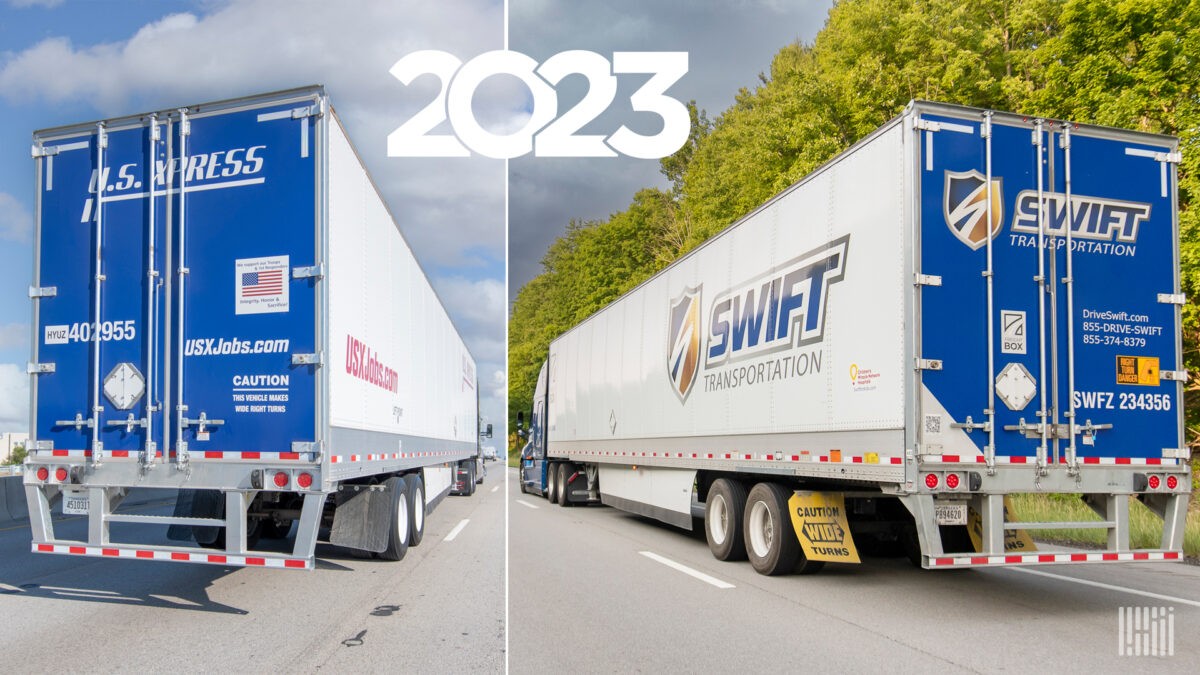
After amassing a nearly $1 billion less-than-truckload platform through two separate deals in 2021, Knight-Swift Transportation (NYSE: KNX) got back to its truckload roots in March, announcing the acquisition of carrier U.S. Xpress in an $800 million-plus deal.
The transaction was booked at nearly 14 times trailing 12 months’ adjusted earnings before interest, taxes, depreciation and amortization, but closer to just 5 times on a forward-looking basis inclusive of deal synergies.
Knight-Swift’s management team has again put its operational chops to the test. It acquired struggling and highly leveraged Swift Transportation in 2017. That $6 billion merger created the largest fleet in the nation. While not as large, U.S. Xpress presents a difficult challenge as it had been operating at a loss.
U.S. Xpress is expected to add $2.2 billion in annual revenue to Knight-Swift’s platform, most of which comes from an asset-based fleet of 7,200 tractors (1,000 of which were provided by owner-operators at the time of the deal) and more than 14,000 trailers. Knight-Swift is now expected to produce $10 billion in revenue with a combined TL fleet of more than 24,000 tractors and 96,000 trailers.
Knight-Swift cut its full-year 2023 earnings guidance when it reported second-quarter results in July. The change was in part due to an expected negative impact from the integration of U.S. Xpress (closed on July 1). By the third-quarter report in mid-October, however, it told investors that the integration was ahead of schedule. The company said it had already achieved a $100 million annual run rate in cost and revenue synergies, with a line of sight to a $120 million run rate by year-end.
The acquisition is expected to produce an operating profit in the first half of 2024 and be accretive to full-year earnings per share. U.S. Xpress is expected to add $1 to EPS by 2026.
U.S. Xpress’ multiyear struggle ends with acquisition by Knight-Swift
Knight-Swift to remain on M&A prowl, still looking at LTL targets
U.S. Xpress lays off staff, reports significant loss to SEC
U.S. Xpress filing confirms closing of sale to Knight-Swift
Knight-Swift lowers Q2 expectations, closes on U.S. Xpress deal
Schneider builds out dedicated operation
Schneider National (NYSE: SNDR) made an M&A splash again in August, acquiring dedicated carrier M&M Transport Services. The deal added 500 trucks and 1,900 trailers, most of which operate in the Northeast, Midwest and Southwest.
Financial terms were not disclosed but Schneider said the deal would be immediately accretive to earnings. The transaction pushed Schneider’s dedicated fleet to nearly 6,500 tractors and $1.5 billion in revenue.
The company plans to acquire a dedicated carrier every 18 months in addition to organic fleet additions of 300 to 500 trucks annually (net of customer churn). The dedicated unit has accounted for 58% of Schneider’s 2023 year-to-date TL revenue.
Schneider acquired two dedicated carriers in 2022. It added Midwest Logistics Systems and its 900 tractors operating throughout the central U.S. in a $263 million deal, and regional operator deBoer Transportation, which onboarded 160 tractors.
Schneider acquires another dedicated carrier
Forward Air, Omni merger still in limbo
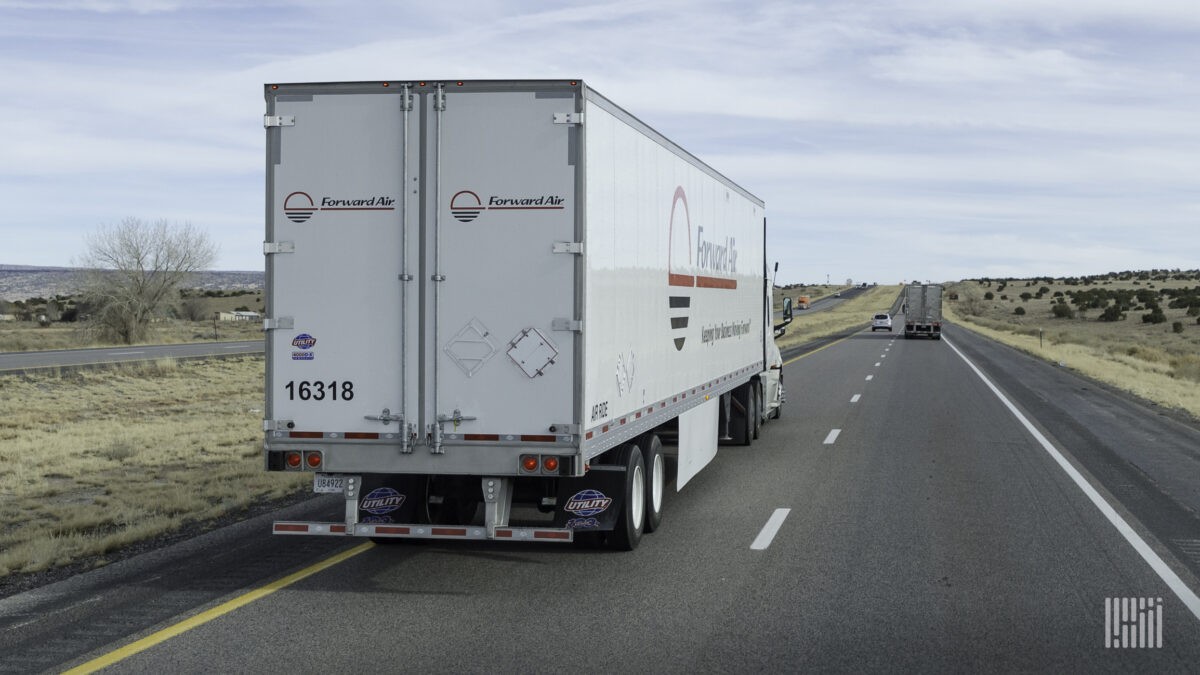
Forward Air (NASDAQ: FWRD) shocked Wall Street in August when it announced plans to merge with freight forwarder Omni Logistics in a $3.2 billion deal (roughly 18 times trailing adjusted EBITDA excluding deal synergies). The strategic merits of the acquisition, the large price tag and the fact that shareholders would not be given a vote ahead of closing were some of the reasons the stock sold off more than 40% following the announcement.
The debt-and-equity transaction would be 38% dilutive to existing shareholders and push the asset-light LTL provider’s debt leverage (net debt-to-trailing 12 months’ adjusted EBITDA) to roughly 4 times at closing.
Some of Forward’s large, institutional holders have openly criticized the merger and called on the company to terminate the transaction. A group of smaller shareholders have attempted to block the deal in a Tennessee court, claiming damages and saying they should be given a vote. Shares of Forward haven’t materially rebounded since the sell-off.
Forward originally said the addition of Omni, which is currently one of its forwarding customers, would allow it to remove the middle man and sell directly to shippers, thereby bolstering margins. Some of Forward’s longtime customers have questioned the deal’s impact as it positions Forward as both linehaul service provider and direct competitor. However, Forward said it has been able to grow volumes with those legacy forwarders since the announcement.
More recently, Forward alleged Omni had failed to meet certain pre-closing requirements and that the updated financial projections it provided were worse than expected. Forward has asked a Delaware court to let it out of the deal.
Trucking M&A was tepid again in 2023 as freight demand slowed. Interest rates stepped higher, which proved a hindrance to deal financing, and tightened credit markets were met by still lofty valuation expectations from sellers.
Through the first week of December, transportation and logistics deal flow was off 2% year over year following 2022’s notable pullback, according to supply chain M&A advisory firm Left Lane Associates. However, companies generating significant cash flow did use M&A to offset weak organic growth.
There were some notable deals in trucking during the year, however. Here’s a recap in chronological order.
Knight-Swift acquires U.S. Xpress
After amassing a nearly $1 billion less-than-truckload platform through two separate deals in 2021, Knight-Swift Transportation (NYSE: KNX) got back to its truckload roots in March, announcing the acquisition of carrier U.S. Xpress in an $800 million-plus deal.
The transaction was booked at nearly 14 times trailing 12 months’ adjusted earnings before interest, taxes, depreciation and amortization, but closer to just 5 times on a forward-looking basis inclusive of deal synergies.
Knight-Swift’s management team has again put its operational chops to the test. It acquired struggling and highly leveraged Swift Transportation in 2017. That $6 billion merger created the largest fleet in the nation. While not as large, U.S. Xpress presents a difficult challenge as it had been operating at a loss.
U.S. Xpress is expected to add $2.2 billion in annual revenue to Knight-Swift’s platform, most of which comes from an asset-based fleet of 7,200 tractors (1,000 of which were provided by owner-operators at the time of the deal) and more than 14,000 trailers. Knight-Swift is now expected to produce $10 billion in revenue with a combined TL fleet of more than 24,000 tractors and 96,000 trailers.
Knight-Swift cut its full-year 2023 earnings guidance when it reported second-quarter results in July. The change was in part due to an expected negative impact from the integration of U.S. Xpress (closed on July 1). By the third-quarter report in mid-October, however, it told investors that the integration was ahead of schedule. The company said it had already achieved a $100 million annual run rate in cost and revenue synergies, with a line of sight to a $120 million run rate by year-end.
The acquisition is expected to produce an operating profit in the first half of 2024 and be accretive to full-year earnings per share. U.S. Xpress is expected to add $1 to EPS by 2026.
U.S. Xpress’ multiyear struggle ends with acquisition by Knight-Swift
Knight-Swift to remain on M&A prowl, still looking at LTL targets
U.S. Xpress lays off staff, reports significant loss to SEC
U.S. Xpress filing confirms closing of sale to Knight-Swift
Knight-Swift lowers Q2 expectations, closes on U.S. Xpress deal
Schneider builds out dedicated operation
Schneider National (NYSE: SNDR) made an M&A splash again in August, acquiring dedicated carrier M&M Transport Services. The deal added 500 trucks and 1,900 trailers, most of which operate in the Northeast, Midwest and Southwest.
Financial terms were not disclosed but Schneider said the deal would be immediately accretive to earnings. The transaction pushed Schneider’s dedicated fleet to nearly 6,500 tractors and $1.5 billion in revenue.
The company plans to acquire a dedicated carrier every 18 months in addition to organic fleet additions of 300 to 500 trucks annually (net of customer churn). The dedicated unit has accounted for 58% of Schneider’s 2023 year-to-date TL revenue.
Schneider acquired two dedicated carriers in 2022. It added Midwest Logistics Systems and its 900 tractors operating throughout the central U.S. in a $263 million deal, and regional operator deBoer Transportation, which onboarded 160 tractors.
Schneider acquires another dedicated carrier
Forward Air, Omni merger still in limbo
Forward Air (NASDAQ: FWRD) shocked Wall Street in August when it announced plans to merge with freight forwarder Omni Logistics in a $3.2 billion deal (roughly 18 times trailing adjusted EBITDA excluding deal synergies). The strategic merits of the acquisition, the large price tag and the fact that shareholders would not be given a vote ahead of closing were some of the reasons the stock sold off more than 40% following the announcement.
The debt-and-equity transaction would be 38% dilutive to existing shareholders and push the asset-light LTL provider’s debt leverage (net debt-to-trailing 12 months’ adjusted EBITDA) to roughly 4 times at closing.
Some of Forward’s large, institutional holders have openly criticized the merger and called on the company to terminate the transaction. A group of smaller shareholders have attempted to block the deal in a Tennessee court, claiming damages and saying they should be given a vote. Shares of Forward haven’t materially rebounded since the sell-off.
Forward originally said the addition of Omni, which is currently one of its forwarding customers, would allow it to remove the middle man and sell directly to shippers, thereby bolstering margins. Some of Forward’s longtime customers have questioned the deal’s impact as it positions Forward as both linehaul service provider and direct competitor. However, Forward said it has been able to grow volumes with those legacy forwarders since the announcement.
More recently, Forward alleged Omni had failed to meet certain pre-closing requirements and that the updated financial projections it provided were worse than expected. Forward has asked a Delaware court to let it out of the deal.
Source: freightwaves.com